
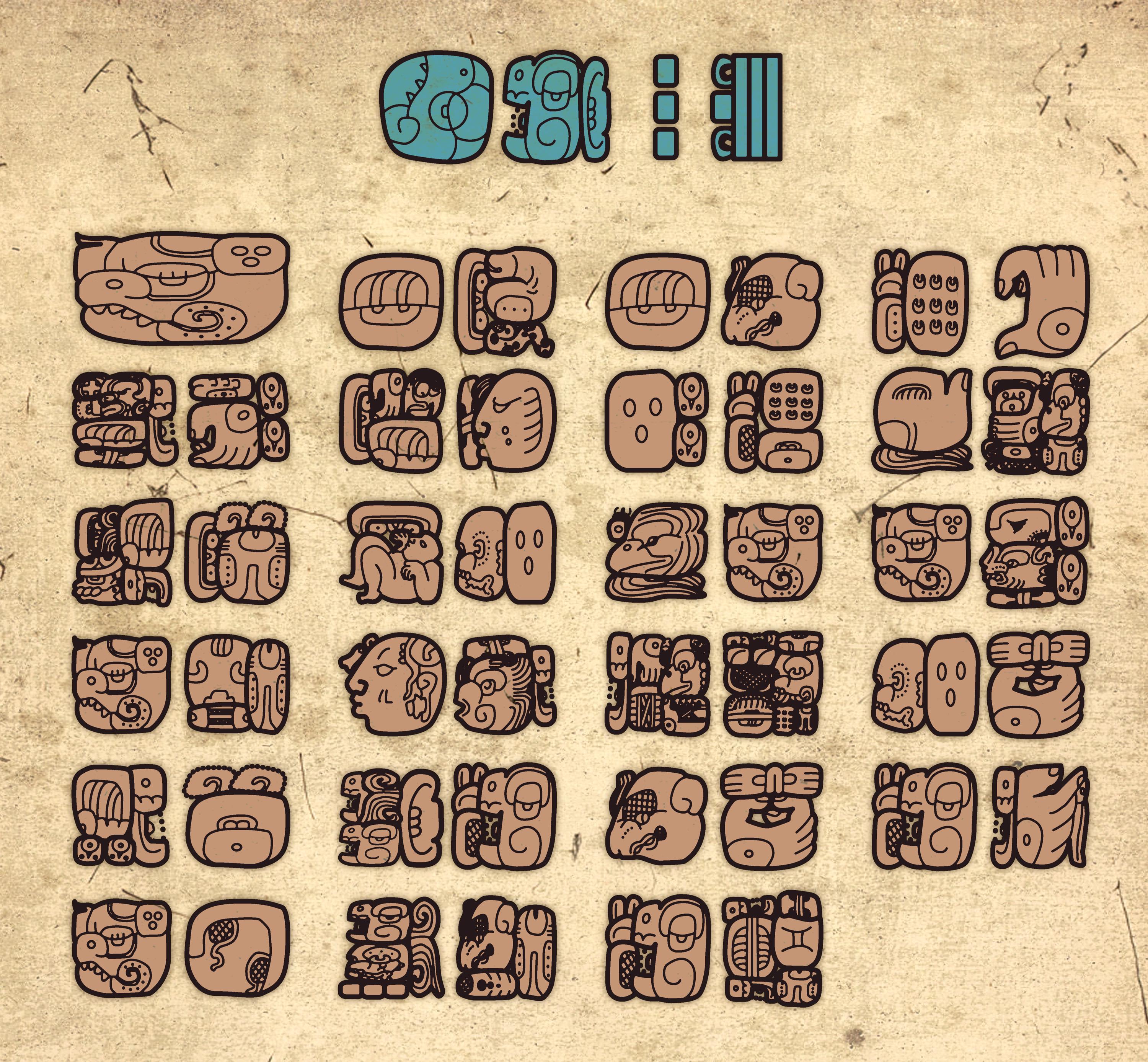
It was my dream to be able to write in Mayan Glyphs, especially when writing a modern version of the language. And this poster I made available on Etsy is the fruit of my intense one-week study of everything I needed to make it happen.
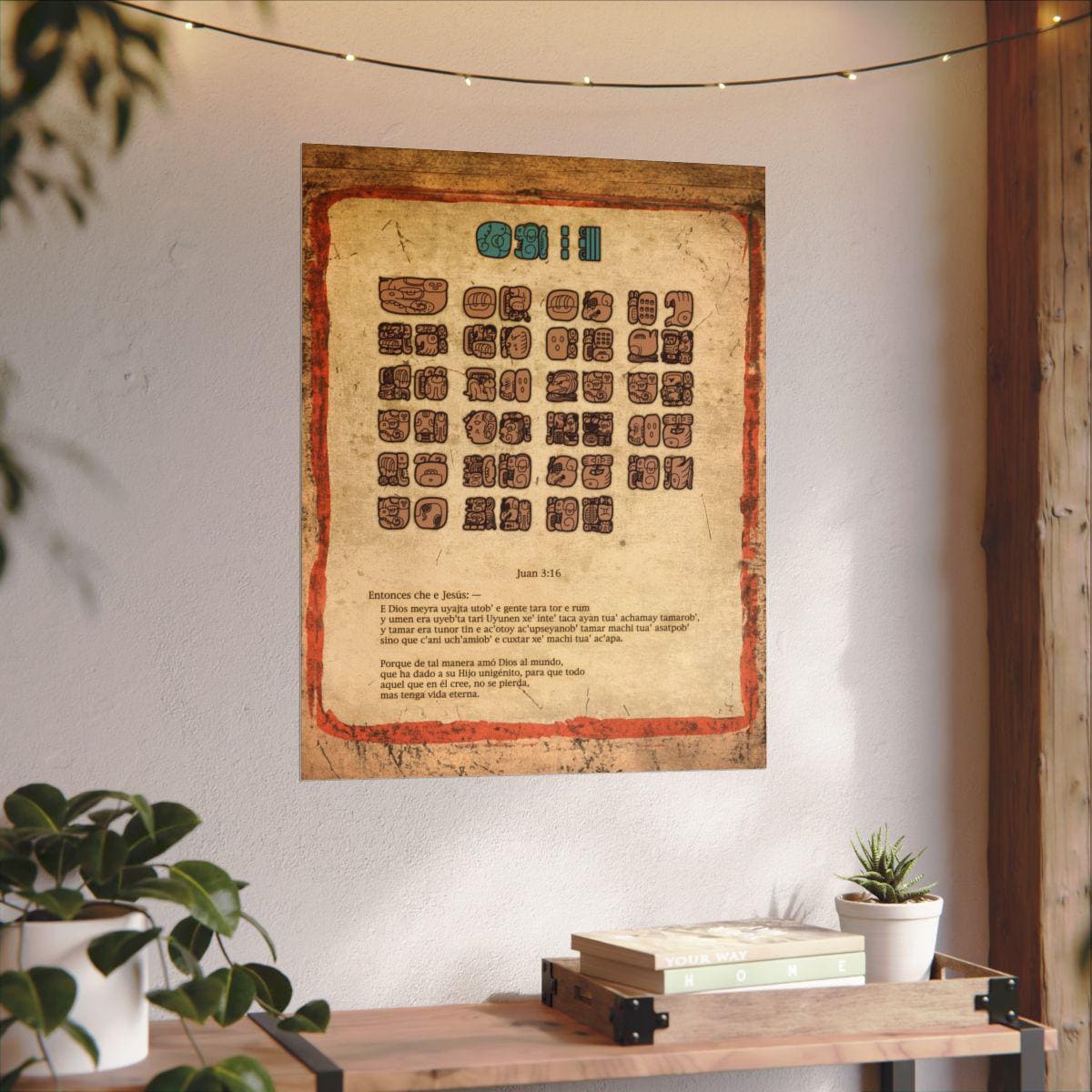
I used John 3:16 as my first subject, since a full New Testament Bible translation has been made. The Bible has been translated in multiple languages which makes it useful for learning Ch'orti' where I have no access to native speakers. I used the Castilian Reina Valera and the English New International Version to figure out the meaning of individual words, plus any dictionary available online to verify and confirm my linguistic analysis.
The official translation (in traditional Spanish-friendly spelling) of John 3:16 is:
"Entonces che e Jesús: —E Dios meyra uyajta utob' e gente tara tor e rum y umen era uyeb'ta tari Uyunen xe' inte' taca ayan tua' achamay tamarob', y tamar era tunor tin e ac'otoy ac'upseyanob' tamar machi tua' asatpob' sino que c'ani uch'amiob' e cuxtar xe' machi tua' ac'apa."
For the Poster I chose to transcribe it as:
ju-a-n(a) 3 16
e CAT-ta-t(a)-a me-y(e)-ra u-ya-j(a)-t(a)-a u-to-b(o) e WINIC-o-b(o) ta-r(a)-a to-r(o) e RUM y u-me-n(e) e-ra u-ye-b(e)-ta ta-ri u-YUNEN xi-e INTE' ta-ca a-y(a)-a-n(a) tu-a a-CHAM-ma-y(a) ta-m(a)-a-ro-b(o) y ta-m(a)-a-r(a) e-ra tu-no-r(o) ti-n(i) e a-c'o-t(o)-o-y(o) a-c'u-p(u)-se-ya-no-b(o) ta-m(a)-a-r(a) ma-chi tu-a a-sa-t(a)-po-b(o) si-no que c'a-ni u-CH'AM-mi-o-b(o) e cu-x(u)-ta-r(a) xi-e ma-chi tu-a a-C'APA
(for glyph compatibility, I replaced some Spanish loan words)
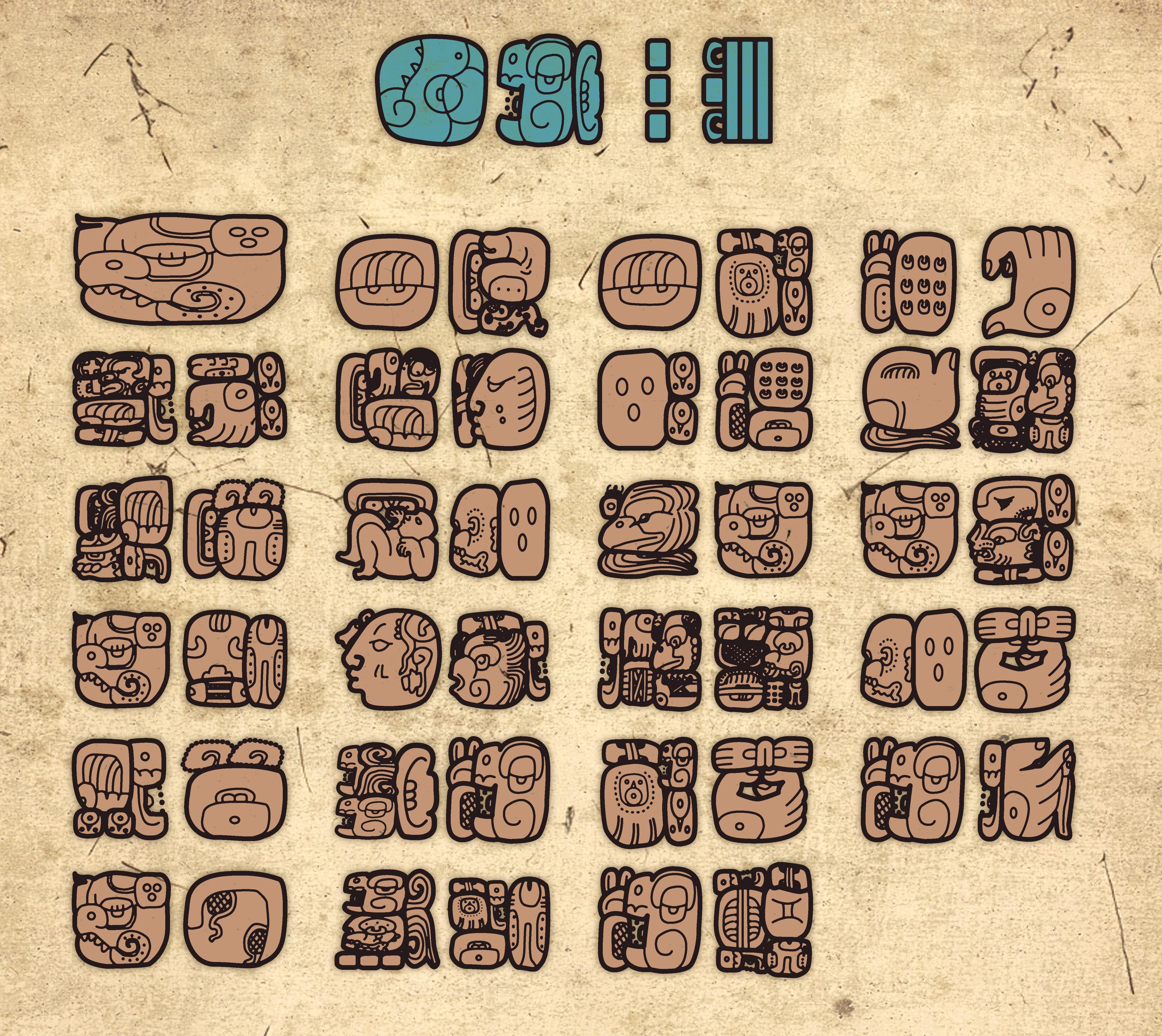
Creating a Ch'orti' orthography with Glyphs
Mayan Glyphs were used in the height of Mayan Civilization until the Spanish arrival (Dr. Diane Davies, The Maya Writing System, MayaArcheologist.co.uk). So far, it is known that at least three prestigious and distinct Mayan languages are represented in these glyphs. The oldest and most represented language is known today as Classical Mayan (endonym: Ch’olti’). Mayan languages are still spoken today, though many are endangered.
Similar to how Latin has evolved to all the Romance languages of today, such as Italian, Spanish, Portuguese, etc. it is believed that Classical Mayan is the direct ancestor of the Mayan Ch’olan branch of the Mayan Family and Ch'orti' is the closest related language of today (Kettunen & Helmke, Introduction to Maya Hieroglyphs 17th Edition, 2020).
For a fun little project, I decided to see what it would be like to use these glyphs to write a modern spoken language. I figured picking a direct descendant might be the best one to start with. So I chose Ch’orti’. Not only that, they are likely my closest Mayan relatives (though my native Central American ancestry is primarily Lenca, the eastern neighbors of the Mayans); the modern speakers of Ch’orti’ live in the regions where the borders of Guatemala, Honduras and El Salvador meet. The same region holds the ancient city state of Copán (Michael D. Coe & Mark Van Stone, Reading Maya Glyphs, Thames & Hudson, 2005).
The rest of this blog will cover how I came about writing these glyphs and what sorts of orthographic rules I had to make in order to make the system work. (Feel free to skip this, if Linguistics bore you).
It is expected that I would have to modify the use of these glyphs in order to adequately transcribe Ch’orti’. Just like how most Romance languages of today now have to use diacritics (e.g. á, è, ü) and invent new letters (e.g. u from v, j from i) and digraphs (th, ch, nh/gn, etc.) in order to fill the gaps left in the original Latin alphabet. In this case, I had no desire to invent new glyphs, especially as an outsider to the community, so I decided to create consistent rules similar to the attempts of the English written language, inspired by the Classical Mayan system of the glyphs.
Disclaimer: I am by no means an expert on Mayan Hieroglyphs, so everything I'm about to discuss comes from research fueled by personal interests and using my limited training in Applied Linguistics.
There are plenty of free resources on how to read the glyphs, so I will not cover that, but will provide a link for anyone interested: Maya Writing System and Hieroglyphic Script - Maya Archaeologist - Dr Diane Davies
Logograms
Mayan glyphs operate very similar to Japan's system of using a combination of Kanji, Hiragana and Katana. They have symbols that represent full words (like Kanji) called logograms and they have syllaberies (like Hiragana and Katakana) called syllabograms, but unlike Japanese, Mayan symbols have many different variations, making it daunting for anyone starting to learn the writing system. To this day, the conventions for spelling the Classical Mayan words are up for debate (Kettunen & Helmke).
When discussing Mayan Glyphs, it is standard practice to represent words in logograms in all caps. Like “BAHLAM” for “jaguar” vs. the syllabograms “ba + la + ma” (Dr. Diane Davies).
Ch'orti has many words that come from words in their ancestral language, fully representable in a logogram. Like the word for “god” which is “kat” the equivalent to “K’UH.” This is why it's worth learning some of the Ch'orti language to see what words can be spelled with a logogram instead of a set of syllabograms (either is acceptable in Classical Mayan).
Syllabograms and Syllable matches
Mayan glyphs use syllabograms, and so when I talk about them, I will refer to their standard transliterated Latin spelling in bold and leave the Ch'orti spellings in italics, similar to how other papers handle it. Both Classic Mayan and Ch'orti’ have the same set of vowels (a, e, i, o, u). I will demonstrate how the syllables match by their sets of represented consonants. So when I say B = B’ assume I mean all ba, be, bi, bo, bu = b’a, b’e, b’i, b’o, b’u.
Modern Mayan speakers often use borrowed words and phrases from Spanish, which is where b, d and g are used, so I ignored them for this exercise.
Here is the list of matching sets, beginning with the Phoneme in IPA, followed by the Classic Mayan Transliteration, and then the equivalent Ch'orti' Letter.
- /m/ m = m
- /p/ p = p
- /ɓ/ b = b’ ← not to be confused with Ch'orti’s b /b/ used in Spanish loan words
- /n/ n = n
- /t/ t = t
- /t’/ t’ = t’
- /t͡s/ tz = tz
- /t͡s’/ tz’ = tz'
- /s/ s = s
- /l/ l = l or r ← the r consonant probably started as an allophone from l, and then got promoted to its own phoneme thanks to Spanish influence (this is my speculation)
- /t͡ʃ/ ch = ch
- /t͡ʃ ʼ/ ch’ = ch’
- /ʃ/ x = x ← *currently there is not a glyph assigned to the syllable "xe"
- /j/ y = y
- /k/ k = k ← some spelling systems use c or que, qui
- /k’/ k’ = k’ ← some spellings systems use c’ or q’ue, q’ui
- /h/ h = j ← the j in Ch’orti’ does not differentiate /x/ and /h/ but Classic Mayan did
- /x/ j = ? ← technically, j also works, but since Ch'orti doesn't distinguish the two sounds, I left the j’s out for this one (could later be used for underrepresented sounds)
- /w/ w = w
"Xe" syllable missing
Since the "xe" syllabogram has not yet been discovered, I decided to combine the glyphs for xi and e to create the sound xe, taking advantage of the palatal nature of the sibilant /ʃ/.
The "r" vs. "l" issue
There's currently no easy way to distinguish the two sounds, without having to create new glyphs or some kind of diacritic. So, for the moment, I left it to the reader to use context to interpret which one is which. So far, it seems that in most cases, the r has replaced l in native words, but the l still exists for Spanish loan words. (I have not been able to find a full comprehensive phonological work of Modern Ch'orti' that's free or easy to access online).
Vowel Echo Rule
One of the common rules I reapplied from Classic Mayan to Ch’orti’ is the synharmony system. Even back then, the Mayans had the challenge of representing word final consonants with their syllabogram system. So they use a thing called Vowel Echo (Houston, Robertson, and Stuart, Disharmony In Maya Hieroglyphic Writing)
For Ch’ort’ I made the following rule:
When two syllabograms have matching vowels, all matching vowels following the first are silent. If the echoing vowel needs to be pronounced, add a matching standalone vowel to indicate it (taking advantage of Ch'orti’s lack of contrasting long vowels.)
CV1C / CV1-CV1 > CV1C
CV1CV1 / CV1-CV1-V1 > CVCV
Example words in Ch'orti’ (vowels in parenthesis are not pronounced):
- xujch → xu+h(u)+ch(u) (this double echo is necessary for CVCC)
- uyajta → u+ya+h(a)+t(a)+a (the matching standalone vowel at the end allows for CV1CCV1)
- xuxub’ → xu+x(u)+u+b(u) (this is necessary for CV1CV1C)
- achamay → a+CHAM+ma+y(a) ("ya" is chosen to match final "y" spelling)
Example of how the rule is applied when vowels don't echo:
- era → e+la
- machi → ma+chi
Absence of Long Vowels
Where Classic Mayan and Ch'orti' would differ, is the long vowel rule. Ch’orti’ has lost the long vowel distinction, so it’s no longer necessary to use the following Classical Mayan rule:
CV1C / CV1-CV2 > CVVC (V1 = a, e, o, u; V2 = i)
CV1C / CV1-CV2 > CVVC (V1 = i; V2 = a)
How it works is basically when the first syllable is a, e, o or u, and followed by a syllable with an i then the i is omitted and the first vowel becomes a long vowel. Inversely when the first syllable is an i and the second vowel is an a, then a is silent and the first syllable vowel becomes a long vowel (Kettunen & Helmke).
Since the rule is not necessary, then it is safe to use these vowel combinations without needing an extra standalone vowel method like the previous rule, simplifying the use of the syllabary.
Glottal Stops
Glottal Stops are an important distinction in both Mayan languages. However, only the Glottalized consonants are represented in the syllabary, leaving the glottalized vowels underspelled.
There is a proposed rule in Classical Mayan on how it could have been represented by a certain combination of syllable vowels similar to the handling of long vowels, but it was difficult to implement without over complicating the orthography.
CV1C / CV1-CV2 > CV’(V)C (V1 = e, o, u; V2 = a)
CV1C / CV1-CV2 > CV’(V)C (V1 = a, i; V2 = u)
If I were to implement this rule, I would have to use a standalone vowel to make sure “-ra” in “era” is pronounced: era → e+l(a)+a
I chose to not use this rule in order to minimize the need of extra standalone vowels that would be used to differentiate syllable pronunciation and leave it to context interpretation (which is how it's often handled anyway in Classical Mayan with its various inconsistencies).
But I did come up with a few spelling variations to distinguish a few syllables if needed:
xe' → xi+e
xe → xi+ye
twa' → tu+a
twa → tu+wa
This is only the start!
There are various solutions the Ch’orti’ people could use to solve the Glottal Stop underspelling problem and the need for new glyphs for sounds that are not compatible to the Classical Mayan Glyphs, but I feel it’s best that the community takes ownership and decide for themselves on how to handle those issue, if they desire it.
The omission of the syllabogram set of J can be used to represent new syllables.
They could create new glyphs, or diacritic markers to create new sounds, similar to how Aljamiado was used to create a Mozarabic or Spanish writing system using Arabic Script, or how Vietnamese use diacritics to make tone marks and vowels that aren’t compatible to Roman Script. Maybe some day a native speaker will stumble upon my work and complete and perfect it for their community.
Sources
For Classical Mayan:
- Kettunen & Helmke, Introduction to Maya Hieroglyphs 17th Edition, 2020
- Dr. Diane Davies, The Maya Writing System, MayaArcheologist.co.uk
- Michael D. Coe & Mark Van Stone, Reading Maya Glyphs, Thames & Hudson, 2005
- Sim Lee and John Pedersen, Learner's Maya Glyph Guide, mayaglyphs.org, 2006
- Houston, Robertson, and Stuart, Disharmony In Maya Hieroglyphic Writing: Linguistic Change And Continuity In Classic Society
For Ch'orti'
- Academia de las Lenguas Mayas de Guatemala, Vocabulario Ch'orti' 2019
- Ed. Charles Wisdom, Chorti Dictionary, 2019
- Wycliffe Bible Translators, Ch'orti': E ojroner xeʼ imbʼutz tuaʼ Cawinquirar Jesucristo, 2012